

Label Sensor
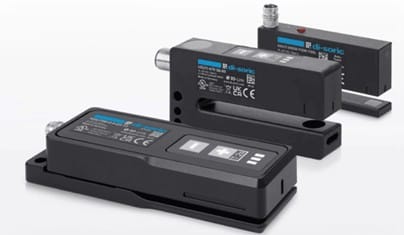
These sensors use a forked beam construction—basically a U-shaped structure where a signal beams from one side to the other.
- Home
- Products
- Label Sensor
Let us help you
Label Sensor
These sensors use a forked beam construction—basically a U-shaped structure where a signal beams from one side to the other. When a label (paper, foil, transparent, thick, thin, metallic, etc.) interrupts the beam, the sensor detects it. Suited for high belt speeds, they offer precise label positioning, critical in fast labeling
They support multiple materials and thickness variations by offering different sensing technologies tailored to each application.
Sensor Types & Strengths
Capacitive (KGUTI series)
- Best for thin, transparent, film or paper labels.
- Works up to 500 m/min speed, detects down to 1 mm thickness.
- Offers reproducibility of up to ±100 µm and response time around 3 ms.
- Models include KGUTI50 (compact, small fork) and KGUTI80 (for wider labels)
- Optical (OGUTI series)
- Male for opaque (paper) labels, both thin and thick.
- Ultra-high speed: up to 500 m/min, with reproducibility ±50 µm and lightning-fast 16 ms response.
- Comes in fork widths from 2–5 mm and depths from 40–100 mm.
- Auto-teach makes switching easy mid-operation without manual adjustment
Ultrasonic (UGUTI series)
- Most flexible: handles metallized, transparent, film, paper, even booklet labels up to ~6 mm thick.
- Runs up to 250 m/min, response time ~25 ms, reproducibility ±200 µm.
- Features 6 mm fork opening, 70 mm fork depth, and robust construction with cleaning blow-through holes Intertronic+2di-soric.com+2.
Smart Features Across All Series
- *Auto–Teach capability: Teach the sensor the ideal switching threshold via one button push—even while the label tape is moving. Also supports remote or IO-Link teach methods
- *IO–Link compatibility: Enables remote configuration, diagnostics, and measurement data exchange while still using a fast switching output in parallel (Pin 2 and Pin 4 setup)Intertronic
- *Robust metal housing with easily detachable halves for cleaning adhesive residue—a real plus in demanding environments Intertronic
Quick Reference Table
Sensor Type | Best For | Max Speed (m/min) | Accuracy (Reproducibility) | Response Time | Fork Size (W × D) |
Capacitive | Thin, transparent, film/paper | ~500 | ±100 µm | ~0.3 ms | KGUTI50: 0.4–1 mm / 50 mm |
Optical | Opaque paper labels (thin & thick) | ~500 | ±50 µm | ~0.16 ms | 2–5 mm / 40–100 mm |
Ultrasonic | Hybrid materials, thick labels | ~250 | ±200 µm | ~0.25 ms | ~6 mm / ~70 mm |
Use Cases & Predictions
- Capacitive models are your go-to when speed and thin, transparent labels are on the menu.
- Optical is lean and mean for high-precision placement of standard paper labels.
- Ultrasonic is the all-rounder—ideal when label types keep changing or include metallic elements or thick inserts.
With IO-Link integration, meaning you’re not stuck physically adjusting sensors during label changes—diagnostics and threshold tweaks happen remotely. That’s the future-looking bit, but also the traditional wisdom of keeping downtime and manual fiddling minimal.
Label Detection
Baumer’s label sensors also rock that U-frame (“fork”) design: light beam travels across, and when a label crosses, the beam disrupts—boom, sensor triggers. Designed for high conveyor speeds and precise label positioning, supporting transparent, metallic, booklet, paper labels, even challenging shapes like round ones~eltra-trade.com+10baumer.com+10baumer.com+10.
Sensor Technologies & Capabilities
Photoelectric Fork Sensors (e.g. model OL05.I-GP1B…)
- Best for opaque labels and standard paper/carrier materials.
- Repeat accuracy: around 15 mm; response time: ~0.16 ms.
- Belt speed: up to 8 m/s (~500 m/min).
- Fork width: ~5 mm; Depth ~10 mm; Housing die-cast zinc, IP67 protection.
- ✨ Auto-teach button for fast format changes (no manual tuning).
- ✨ IO-Link support enables remote sensitivity adjustment and diagnostics.
Laser-Level High-Speed Fork Sensors (e.g. OG series OG080U…)
- Standout precision: repeat accuracy as tight as 01 mm, hysteresis < 0.05 mm.
- Response time: < 0.1 ms, switching frequency up to 10 kHz.
- Fork widths from 10 – 170 mm; supports detecting objects ≥0.2 mm.
- Laser or red–light LED beam; adjustable via IO-Link or potentiometer.
- Ideal when detecting very fine print marks or tiny label edges.
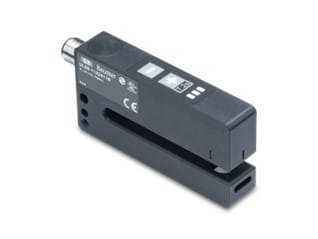
Ultrasonic Label Sensors (like UL06)
- Handles transparent, metallized, film, and thick booklet labels reliably.
- Response time ~25 ms, repeat accuracy around 0.2 mm, up to 6 mm label thickness.
- Belt speeds up to ~4 m/s (~240 m/min). Dynamic teach & IO-Link enabled.
- Housing IP67, push-pull output, teach-in settings via button or IO-Link.
Quick Reference Table
Sensor Type | Label Types | Speed (m/s) | Accuracy | Response Time | Fork Width / Depth |
Photoelectric Fork | Paper, opaque labels | ~8 m/s | ±0.15 mm | ~0.16 ms | ~5 mm / ~10 mm |
Laser High-Precision | Ultra-thin printed marks, fine labels | ~same | ~±0.01 mm | <0.1 ms | 10–170 mm / varied |
Ultrasonic Fork (UL06) | Transparent, metallic, thick labels | ~4 m/s | ±0.20 mm | ~0.25 ms | ~6 mm / ~70 mm |
Why Use These: Features That Matter
- Auto–Teach / qTeach: One-button configuration for each new roll of labels—no manual fiddling.
- IO–Link Interface: Manage thresholds remotely, store sensor recipes, monitor diagnostics live.
- Built tough with IP67, die-cast housings, and optical benefits like immunity to contamination fluctuations.
- Designed so conveyor downtime and manual calibration become ancient history.
Key Application Tips
- Use photoelectric forks for fast detection of standard opaque labels.
- Tap into laser–level forks when labels have super fine features or require exceptional positional precision.
- Choose ultrasonic if labels include metallic strips, are transparent, multi-layered, or thick — especially when shifting materials mid-line.
Ultrasonic label sensors
Ultrasonic label sensors

di-soric Sensor
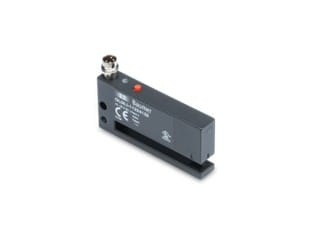
A di-soric Label Sensor is a specialized fork-shaped industrial sensor designed to precisely detect and position labels on a moving backing tape at high speeds.